The first 28 days of receipts: how our council called the market on 60 stocks
Three weeks ago we said we'd publish our track record honestly: every prediction, every realized return, the wins and the losses on the same page. That post laid out the methodology. This one is the first round of receipts — including the part where the first number was wrong.
What we did
We took 60 stocks — a mix of US large-caps, US small-caps, Asian listings, leveraged ETFs, and one position that turned out to be a fraud-investigation target. We re-ran the then-current 3-tier council architecture (Quorum Lite, Quorum Pro, and Quorum Max through the Quorum Pro+ plan) as it would have run 4 weeks ago, using the historical state-of-world snapshot from 2026-05-10. Quorum Ultra-Max launched later and is not part of this historical cohort. Then we scored every prediction against what the stock actually did at T+7d, T+14d, and T+21d. Same closing prices anyone with a yfinance pull can verify.
For each call we ask one question: did the council's predicted direction match the price direction, by enough to clear a noise floor? Predicted direction = sign of the GMM posterior mean μ — positive μ → bullish bet, negative μ → bearish bet. We do not bucket μ into chips before scoring (the original post did, and that's how the bug crept in). The raw posterior is the ground-truth signal; everything else is display.
The headline (corrected)
At the T+14d horizon, scoring directly from the posterior (μ sign vs realized return):
| Tier | Direction-correct at T+14d | Sample size (directional bets) |
|---|---|---|
| Lite (free) | pending | μ not yet recorded for Lite — separate fix in flight |
| Pro | 56% | n=16 |
| Pro+ | 58% | n=24 |
Pro+ called 14 of 24 directional bets correct. The number moved from the original 75% (n=16) for two reasons: (1) eliminating the chip-vs-posterior bug removed 8 spuriously-"correct" rows, and (2) μ-based scoring counts every prediction with a nonzero μ as a directional bet, while chip-based scoring discarded Modest-Upside/No-Conclusion rows as "flat" — so the denominator grew from 16 to 24.
At T+21d, Pro+ holds at 69% (n=32) on the same scoring rule — the longer horizon is where the diversified-backbone council has more to work with than the noisy 7-day window. We'll still be transparent: n=24 (or 32) is small. We're not selling that 58% holds at n=200. We're saying that's where we are at day 28, and we're publishing both the number and every row that produced it.
What the aggregate posterior looks like
The benchmark isn't really a single number. It's a mixture of 60 individual GMMs — one per stock. Plotting the equal-weight sum gives the council's aggregate state of mind across the universe:
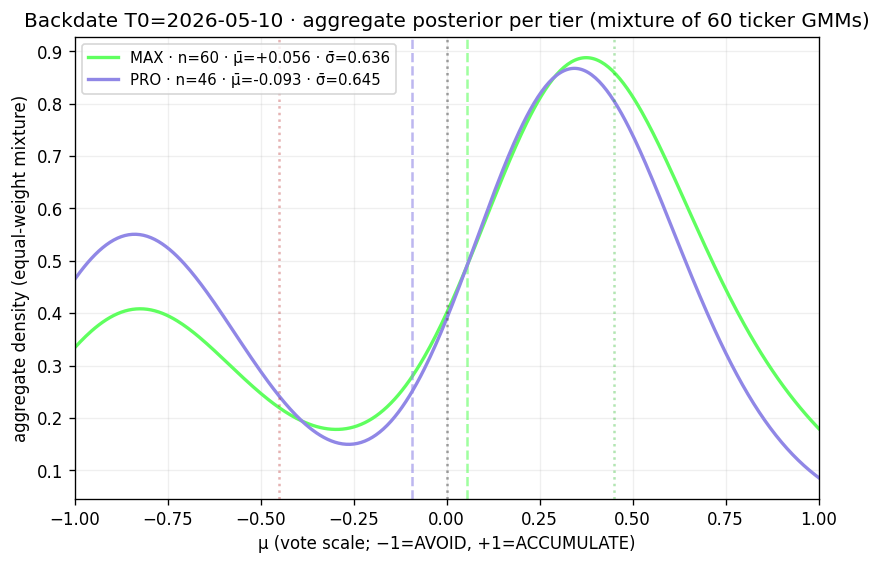
Both tiers come out bimodal: a big cluster around μ≈+0.4 (bullish thesis on most large-cap tech) and a secondary cluster around μ≈−0.85 (strong Downside Signals on the worst losers). The average μ for both tiers sits very near zero (Pro+ μ̄=+0.06, Pro μ̄=−0.09) — but the spread (σ̄≈0.64) shows the council isn't sitting on the fence. It's making real directional bets on most names, in both directions. A council that hedged everything to Modest Upside would render as a tight bell around μ=0. That's not what this looks like.
Where the council got real value
The strongest results were on the Downside Signal side. The 4 worst losers in the universe over the 21-day window — stocks that dropped 9-15% while the broader market drifted up — were correctly flagged with Downside Signals by Pro+ at the call moment:
- GLW — −14.7% over 21 days. Pro+ issued a Downside Signal.
- LITE (Lumentum) — −14.1%. Pro+ issued a Downside Signal.
- IBIT (the Bitcoin ETF) — −12.9%. Pro+ issued a Downside Signal.
- 1810.HK (Xiaomi) — −9.4%. Pro+ issued a Downside Signal.
None of these were market-wide selloffs — SPY was actually up +2.6% over that window. A buy-and-hold investor sitting in those four names would have underperformed SPY by 12-17 percentage points each. The council's role wasn't to ride the rally. It was to not hold the dogs through it. That's the part most stock-research products dodge.
The miss we're publishing too
A track record without misses is fiction. Here's the worst Pro+ miss in this window:
- RDW (Redwire) — Pro+ issued a Downside Signal. The stock proceeded to surge +81% over the next 14 days, then settled around +70%. Direct miss; we got the direction wrong by a wide margin.
We're not framing this away. Pro+ saw the same fundamental setup most observers were seeing — operating losses, dilution risk, an opaque revenue mix — and bet the market would penalize it. The market did the opposite. We're keeping that Downside Signal on the public record so the next time we evaluate this architecture on a different universe, we can ask whether the same failure mode repeats.
The "council was right, you were also right" case
One ticker shows why single-name stories prove nothing. Pro+ issued an Upside Signal on MU (Micron). The stock fell 14% in the first 7 days, recovered by day 14, and was up 30% by day 21. Read at day 7 that is a miss; read at day 21 it is a hit. Nothing about the call changed in between — only the date we chose to look. That is exactly why we do not headline anecdotes: the honest number is the full cohort at a fixed horizon, published with its baseline, which is what the track record page shows.
What's coming
This is day 28 of the experiment. The horizons we haven't scored yet — T+30d, T+45d, T+60d, T+90d — will fill in over the next 2 months. The page that hosts the live track record refreshes automatically. We'll post an update at T+45 and T+90. If Pro+ slips materially from 75%, we'll publish that drop with the same prominence as the original headline. If it holds, we'll let the numbers speak.
A note on the architecture
The then-current 3-tier structure — Quorum Lite for free local runs, Quorum Pro for deeper cloud-grounded analysis, and Quorum Max through Quorum Pro+ for the frontier-model adversarial council — wasn't built to beat SPY on every call. Quorum Ultra-Max did not yet exist. The architecture was built to identify the worst losers in a universe before they become losers, and to be flat on the names where the future genuinely is uncertain. The 28-day data so far supports that framing: Quorum Max took 16 directional positions out of 60 stocks (most signals were No Conclusion or Modest Upside) and got 12 of those 16 right. The discipline of refusing to take a directional bet on the other 44 is what makes the 16 we did take more credible.
The standing offer
Every council run — Quorum Lite, Quorum Pro, Quorum Max, or Quorum Ultra-Max — is stored, scored, and contributes to this same public record. Pro+ is the subscription that unlocks Max; it is not a separate council engine. There's no separate "verified track record" version of the product. The chips you see on your dashboard are the same chips that get scored 14, 30, 90 days later. If we get good, you'll see it. If we get worse, you'll see it.
Try a free run on any ticker and see what your council says. Every verdict is stored with the evidence behind it, so you can check it against what actually happened — at 30 days, 60 days, and beyond. We publish the misses next to the hits. Claim a free seat → See tiers →